


Financial markets were already in a sensitive spot at the end of February amidst a growing backdrop of challenging economic and inflationary data and heightened vulnerability of companies susceptible to disruption from the advancement of AI technology. The initial strikes on Iran have since grown into a more widespread conflict across the Middle East, sparking more broad-based selling of risk assets since the start of the month. In mere days, we have seen crude oil skyrocket past $100 per barrel, over $6 trillion in market value wiped out from global stocks, and the U.S. 10-year Treasury yield spike from nearly 3.9% to over 4.1%, while both gold and the U.S. dollar have served as safe-haven assets as investors search for relief. Geopolitical events can shake our confidence, both in daily life and in our portfolios. Even so, history makes it clear that sticking to a disciplined, long‑term plan is one of the most effective ways to navigate uncertainty.
The escalating conflict in Iran is still a fluid situation with many unknown variables, creating angst amongst investors as they assess how the global economy will be impacted moving forward. Heightened fear and uncertainty are evidenced by the CBOE Volatility Index (VIX), also known as Wall Street’s “Fear Index.” We started this week with an intraday spike in the VIX to a reading over 30, a level often regarded as a key level of greater market fear and uncertainty. Jumps in the VIX often feel like they happen in tandem with specific points in time that can be uncomfortable as an investor. But what does this mean for financial markets moving forward? Markets trend higher over time, and as we analyze key periods of heightened volatility over the past 30 years, you may be surprised to see that returns on the S&P 500 are mostly positive over various timeframes following this initial spike in volatility.

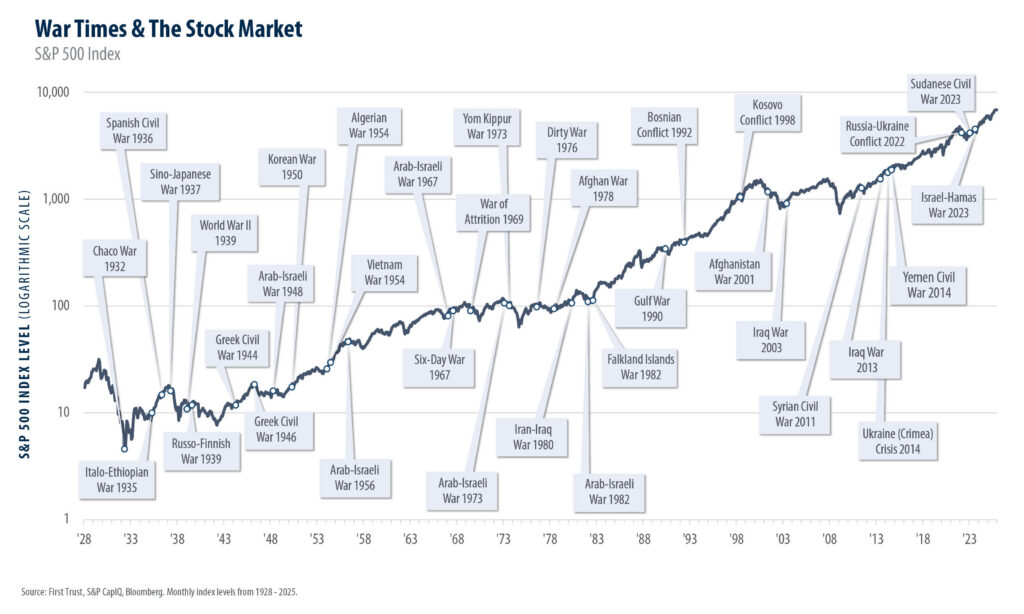
Conflict has been a constant throughout history, yet markets have repeatedly proven their ability to withstand and recover from periods of turmoil. Despite temporary setbacks, the long‑term upward trend remains intact – reinforcing the importance of staying invested through uncertainty.
While the above evidence should be a timely reminder to stay invested in the market, there are some tangible risks that still need to be considered – mainly, the spike in oil prices and what that means for the broader economy. Energy costs have skyrocketed and prices at the pump have gone up considerably in a short period of time, putting upward pressure on inflation and further pressure on the Fed to set interest rates at an appropriate level to achieve its goal of stable prices. As mentioned in our last update, the Strait of Hormuz – which carries approximately one-fifth of the world’s oil – remains closed, explaining much of the significant jump in oil prices. However, the impact to the U.S. economy might be much more isolated. Energy goods and services account for less than 4% of U.S. consumer spending and about half of that is gasoline. Bank of America Merrill Lynch estimates that a 10% increase in crude oil prices would raise PCE inflation by only 0.10% in the near term, and an overall 10% increase in energy prices would weigh on U.S. GDP by up to 0.10%. These figures may seem small, but the U.S. is now a net exporter of oil and gas. The spike in oil and energy costs has already transpired, and the biggest variable moving forward is how long or persistent this price shock will last.
After several years of above-average returns in the stock market, investors may feel more tempted than usual to use heightened volatility or geopolitical turmoil as an excuse to take risk off. At JNBA, we emphasize a disciplined investment approach grounded in an intermediate‑ to long‑term perspective, avoiding reactive decisions based on short‑term events. While historical patterns may not specifically repeat, they often rhyme and can offer meaningful insights – and the evidence strongly supports remaining invested through geopolitical uncertainty. Market volatility can also create compelling rebalancing opportunities, and our structured 10-business-day portfolio review process enables us to take advantage of these moments strategically.
Due to various factors, including changing market conditions and/or applicable laws, the content may no longer be reflective of current opinions or positions. Moreover, you should not assume that any discussion or information contained in this blog serves as the receipt of, or as a substitute for, personalized investment advice from JNBA Financial Advisors, LLC.
Please see important disclosure information at jnba.com/disclosure