


As the third quarter draws to a close, investors are navigating a market shaped by competing forces. Corporate earnings remain remarkably strong, economic growth has proven more durable than many expected, and enthusiasm surrounding artificial intelligence (AI) continues to fuel investment and innovation. At the same time, inflation remains above the Federal Reserve’s target, geopolitical tensions persist, and interest rates have moved higher as policymakers focus on restoring price stability. The market is still advancing, albeit with narrow leadership, weakening breadth, and heightened sensitivity to economic data, monetary policy, and global developments.
Entering 2026, many investors anticipated a year defined by easing inflation and lower interest rates. Today, the economic landscape has become more complicated, as inflationary pressures have proven more persistent than expected, prompting the Federal Reserve to maintain a restrictive policy stance. Chairman Kevin Warsh described the September 25 basis point hike as “removing a dose of accommodation” since economic activity remains generally healthy, signaling that inflation remains a primary concern. Federal Reserve policymakers also indicated that additional tightening is possible before year-end, underscoring the view that interest rates may stay higher for longer.
Despite these challenges, the U.S. economy has remained resilient. Consumer spending, labor market conditions, and corporate profitability have largely withstood higher borrowing costs. Corporate results throughout the year have consistently exceeded expectations, providing support for equity markets even as investors have been forced to reassess their outlook for monetary policy. Strong economic fundamentals have allowed markets to absorb periods of volatility that, in a weaker environment, might have had a more significant impact on investor sentiment and overall market performance.
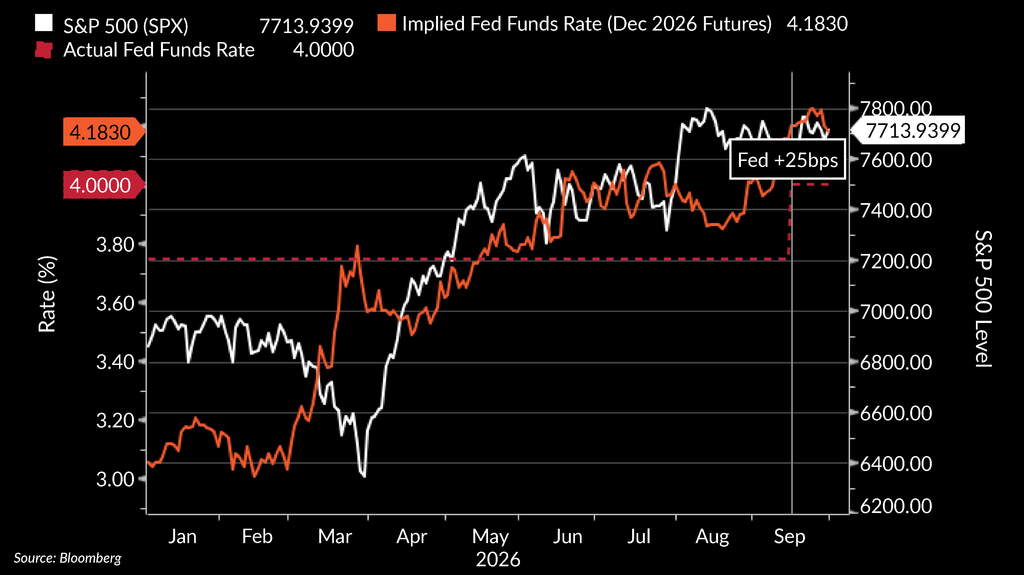
In recent weeks, rising Treasury yields have drawn increasing investor attention, reflecting shifting expectations for future inflation and monetary policy. As investors adjust to the possibility of a higher-for-longer interest-rate environment, bond yields have risen to levels not seen in many years, creating both challenges and opportunities across asset classes. While higher yields can pressure equity valuations in the short term, they also improve prospective returns for fixed income investors and highlight the value of maintaining diversified portfolios.
Geopolitical uncertainty remains an important consideration, particularly as energy-market disruptions have contributed to renewed inflation concerns as well as higher interest-rate expectations. With developments in the Middle East heavily influencing energy markets, investors are reminded that unexpected events can quickly alter the market narrative. Crude oil prices rose sharply during September as supply concerns intensified, adding to worries that inflation may prove more persistent than previously expected. To date, markets have demonstrated resilience in the face of these headlines, but geopolitical risks remain a key variable heading into year-end.
At the same time, one of the strongest themes supporting markets continues to be investment in AI. While discussions about AI often focus on the long-term transformational potential of this technology, the immediate beneficiaries have largely been the companies providing the infrastructure necessary to power it. Semiconductor producers, data-center operators, networking providers, and cloud-computing platforms have continued to see strong demand as businesses invest aggressively in AI-related capabilities. In many respects, the “picks and shovels” analogy is as relevant today as it was earlier in the year.
While year-to-date market performance has been encouraging, elevated valuations and higher interest rates suggest investors should maintain realistic expectations. Strong earnings growth has supported current market levels, but future returns may increasingly depend on continued profit growth rather than expanding valuations. Midterm elections remain a short-term catalyst for pronounced volatility and another factor for investors to consider. Looking beyond the next few weeks, periods of volatility should be expected as markets navigate the tension between solid economic fundamentals and a higher-for-longer interest-rate environment.
As we look toward the final quarter of 2026, we remain cautiously optimistic and reinforce the importance of a diversified investment portfolio. The economy continues to demonstrate resilience, corporate earnings remain healthy, and technological innovation continues to create meaningful opportunities. However, inflation, monetary policy, geopolitical developments, and the path of interest rates remain key risks that warrant careful monitoring. Rather than reacting to short-term market movements, we believe investors are best served by focusing on long-term objectives. The JNBA Investment Committee remains committed to monitoring developments closely, identifying opportunities where appropriate, and helping clients navigate an increasingly complex investment landscape. As always, we encourage you to reach out to your JNBA Advisory Team with any questions regarding your portfolio or the current market environment.
Due to various factors, including changing market conditions and/or applicable laws, the content may no longer be reflective of current opinions or positions. Moreover, you should not assume that any discussion or information contained in this blog serves as the receipt of, or as a substitute for, personalized investment advice from JNBA Financial Advisors, LLC.
Please see important disclosure information at jnba.com/disclosure