
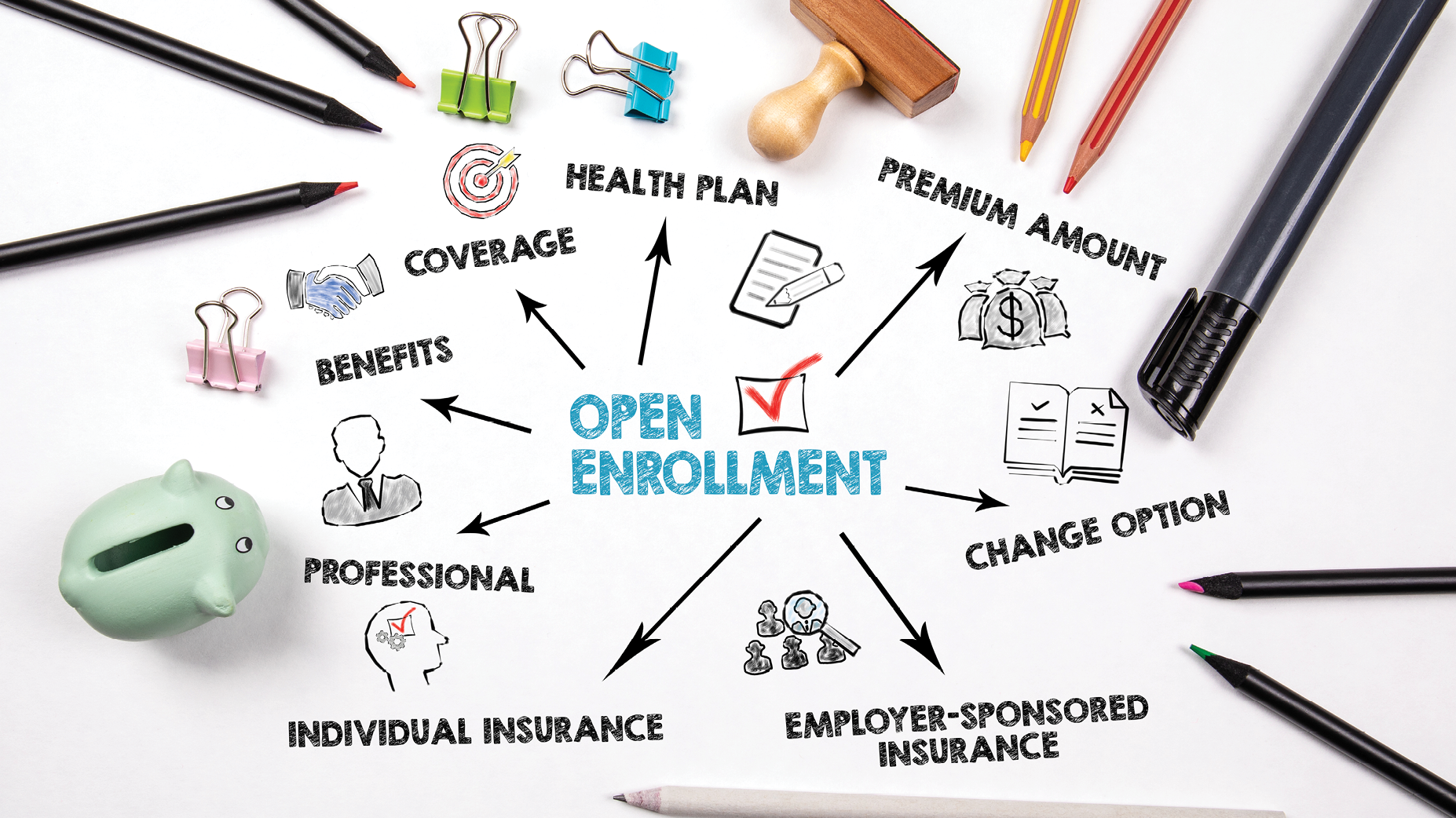
As we enter open enrollment season, it’s easy to fall into the habit of simply renewing last year’s elections. However, open enrollment is an excellent time to reassess and potentially enhance your benefit selections for the upcoming year. If you’ve experienced any life changes in 2026 (e.g., getting married) or have big events planned for 2027 (e.g., welcoming a baby), it’s especially important to review your benefits to ensure they still align with your needs.
Here are key areas to review during this year’s open enrollment:
Retirement Plans
- Review your contribution elections. Are you contributing enough to receive your employer’s full match? If you expect a raise in 2027, consider whether your raise allows you to increase your contributions while meeting your cash flow needs.
- Maximize contributions. For 2027, the maximum contribution limit is increasing to $25,500 for those under age 50. If you were contributing the maximum in 2026, be sure to adjust your deferral to account for the increase.
- Catch-up contributions. For those age 50 or older in 2027, you may be eligible to make a catch-up contribution to your employer retirement plan. If you are eligible, you can contribute an additional $8,500 to your 401(k) plan in 2027.
- Special catch-up contributions. If you are 60 to 63 years old in 2027, you are eligible for a special catch-up contribution amount of $11,750 (versus the normal $8,500 catch-up).
- Be aware of Roth catch-up requirements. SECURE 2.0 requires certain higher-income employees who make catch-up contributions to make those contributions on a Roth basis. For 2027, the applicable prior-year FICA wage threshold is $155,000.
- Traditional or Roth 401(k)? If your plan offers both, decide if it makes sense to allocate contributions to one or both options.
- Check for additional retirement plans. Does your employer offer extra plans like an ESOP or Deferred Compensation Plan? Review eligibility, contribution rules, and any employer contributions or matching opportunities in these programs.
- Review investment allocations. If you manage your 401(k) investments, this is a good time to confirm that your allocations are still appropriate.
- Changes in retirement plan providers? If your employer switched plan providers, review the new platform to help ensure you understand your options and confirm details like beneficiary designations.
Insurance Benefits
- Health, vision, and dental insurance. Review your coverage to confirm it still fits your needs, especially if your family circumstances have changed.
- Compare health insurance options. Consider the total cost, including premiums, deductibles, and co-insurance. If applicable, compare the coverage and options available through your employer and your spouse’s employer.
- HSA or FSA? If you’re eligible for a Health Savings Account (HSA) or Flexible Spending Account (FSA), review contribution limits and whether your employer contributes to these accounts. Remember, FSAs are “use-it-or-lose-it” within the plan year, but HSAs can accumulate and grow over time. Note that some health FSAs permit a limited carryover or grace period.
- FSAs offer two opportunities to save: Dependent Care and Health Care FSAs both offer tax-advantaged ways to pay expenses, with the former covering eligible dependent care costs and the latter covering qualified healthcare expenses.
- Dependent Care FSA: The dependent care FSA limit is $7,500 for single taxpayers or married couples filing jointly and $3,750 for married taxpayers filing separately.
- Health Care FSA: The employee contribution limit for 2027 is $3,500. The maximum permitted carryover from a 2027 plan year is $700, if the employer’s plan allows carryovers.
- HSA contribution limits for 2027 are increasing to $9,000 for family plans and $4,500 for individuals. If you are age 55 or older in 2027, you can contribute an additional $1,000 “catch-up” contribution to your HSA.
- FSAs offer two opportunities to save: Dependent Care and Health Care FSAs both offer tax-advantaged ways to pay expenses, with the former covering eligible dependent care costs and the latter covering qualified healthcare expenses.
- Dental coverage. Determine if you’ll need additional coverage in the coming year, such as for orthodontic work, and confirm whether it’s covered.
- Wellness programs. Does your health insurance provide discounts for participating in wellness programs or toward gym memberships?
Life, Disability, and Long-Term Care
- Many employers provide basic life insurance—confirm the amount and consider if you need supplemental coverage, especially if others rely on your income. Compare employer policies with individual term life policies to evaluate coverage and rates.
- Determine if spouse or child life insurance options are appropriate for your family.
- Review whether long-term disability coverage of 60–65% of your income would meet your needs, and check whether your employer or you are paying the premiums. If you pay the entire premium with after-tax dollars, your disability benefits are generally excluded from federal taxable income.
- Review any long-term care insurance options offered by your employer and check if whether coverage extends to your spouse.
Miscellaneous Benefits
- Legal services. Some employers offer stipends for legal services or access to online resources. If available, this is a great opportunity to establish or update important documents like a Trust, Will, Power of Attorney, or Health Care Directive.
- Commuter benefits. Some employers allow employees to set aside pre-tax dollars for eligible public transportation and qualified parking expenses. For 2027, the monthly tax-free limit for qualified transit benefits and the separate monthly limit for qualified parking increases to $350 per month, compared with $340 in 2026.
- Tuition reimbursement. If you’re considering further education in 2027, check whether your employer offers tuition assistance.
- Financial planning benefits. When working with a financial advisor (or if you plan to do so), see if your employer offers any stipends or benefits for financial planning services.
- Tax withholding review. Review your tax withholdings on your most recent paycheck. If you’re at risk of being under-withheld for the 2026 tax year, update your withholding elections as appropriate to help reduce the risk of an underpayment penalty.
Open enrollment is a valuable time to confirm your benefits align with your current and future needs. Don’t hesitate to consult your Human Resources department for clarification or reach out to your JNBA Advisory Team for additional guidance.
Please note: JNBA is not an attorney and no portion of the above should be construed as legal advice. All legal issues should be addressed with the legal professional of your choosing. JNBA is not an accountant and no portion of the above should be construed as accounting advice. All accounting issues should be addressed with an accounting professional of your choosing. JNBA is not an insurance agent and no portion of the above should be construed as insurance advice. All insurance issues should be addressed with the insurance professional of your choosing. JNBA nor its employees sell insurance products. Due to various factors, including changing market conditions and/or applicable laws, some of the content may no longer be reflective of current opinions or positions. Moreover, you should not assume that any discussion or information contained in this blog serves as the receipt of, or as a substitute for, personalized investment advice from JNBA Financial Advisors.
Please see important disclosure information at jnba.com/disclosure