

Successful investors pay attention to how every dollar is working, including the ones sitting on the sidelines. Box spreads are one advanced cash management tool worth understanding. They are a complex options strategy that can create a more predictable outcome than many other strategies. This article covers how they work, when they may be used, and what risks investors should understand.
Table of Contents:
Evaluating advanced investment strategies is one part of a strong financial plan. That’s where we come in.
What Is a Box Spread?
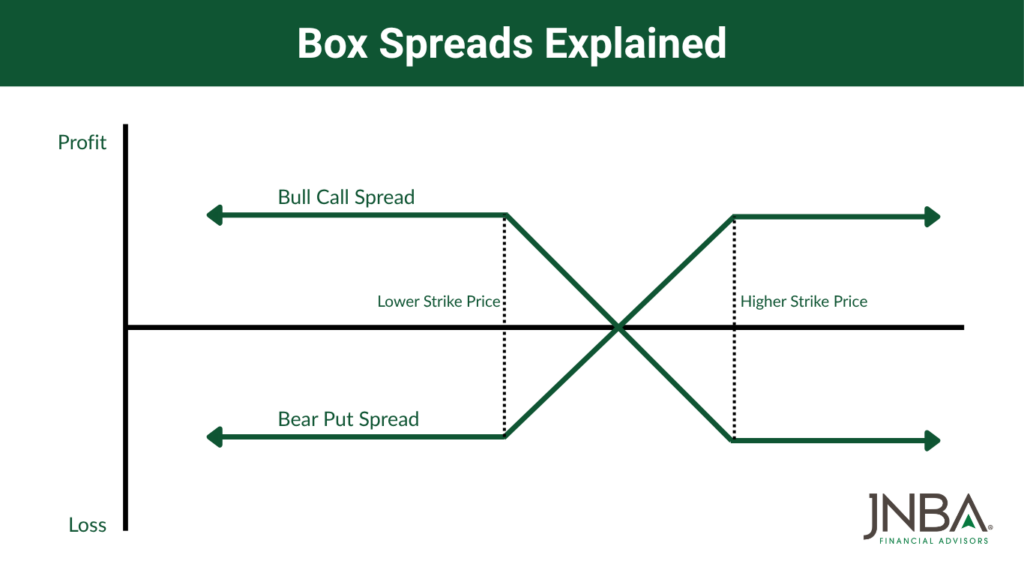
A box spread combines four options contracts (a bull call spread paired with a bear put spread) in a way that largely removes the effect of market movements. Instead of trying to profit from a rising or falling market, the strategy is designed to create a predetermined value at expiration. Depending on how the position is structured, an investor either pays a net debit upfront in exchange for a fixed payout at expiration or receives a net credit upfront in exchange for repaying a fixed amount at expiration. That difference between what’s paid and what’s received represents the borrowing cost, or implied interest rate, on the synthetic loan.
This is what makes box spreads useful for cash management. The outcome at expiration is known before the position is opened, regardless of what markets do in the interim. However, that defined outcome is before costs. Execution costs, taxes, and early assignment risk can all affect the actual return and are covered in more detail in the Risks and Considerations section below.
How Box Spreads Work
A box spread combines two smaller option strategies: one using calls and one using puts. The bull call spread consists of buying a call at a lower strike price and selling another at a higher strike price. The bear put spread consists of buying a put at the higher strike and selling another at the lower strike. All four legs must share the same lower strike, the same higher strike, and the same expiration date. When the full position is assembled, the trade is structured to have a known value at expiration regardless of how the underlying moves.
Long Box Spread
A long box spread means buying the full position. Investors pay a net debit upfront in exchange for receiving the fixed spread value at expiration. A long box can be a good option when the cost to enter is lower than the expected payoff, allowing them to earn a known return on uninvested cash. It functions as a way to lend money synthetically through the options market. It’s similar in concept to a short-term fixed income instrument but executed through box spread options.
Short Box Spread
A short box spread means selling the full position. It involves receiving a net credit today and committing to repaying a fixed amount at expiration. The difference between what is received and what is repaid is the implied borrowing cost. Investors may consider a short box spread when that implied rate compares favorably to alternatives such as securities-backed lines of credit (SBLOCs) or margin loans. When structured correctly, it functions as a box spread loan: a fixed-term, synthetic borrowing arrangement executed through the options market.
Understanding where a strategy like this fits in with your broader financial plan is key. JNBA can help.
Box Spread Example
Here is a simplified example of how a long box trade is structured. Suppose a stock is trading at $51, and an investor constructs a box spread using $49 and $53 strike prices. The four legs are buying the $49 call, selling the $53 call, buying the $53 put, and selling the $49 put. They cost $378 to enter on a net basis. The spread between strike prices is four points. At 100 shares per contract, the position settles at $400 at expiration, regardless of where the stock trades.
The $22 difference between entry cost and settlement value represents the potential return, before commissions and fees. On a margin this narrow, execution costs are not a secondary concern. They are central to whether the box trade makes financial sense, which is why fill price is a primary focus when entering any box spread.
When to Use Box Spreads
The box spread options strategy is primarily a cash management tool, not a directional trading strategy. A long box spread can earn a defined return on uninvested cash. It functions similarly to a short-term Treasury bill but is executed through the options market. A short box spread can provide access to liquidity at implied rates that may compare favorably to more conventional alternatives.
Consider a common scenario: a high-net-worth individual needs liquidity for a major purchase, a near-term tax liability, or a strategic financial opportunity, but they hold most of their wealth in a taxable investment portfolio. Selling appreciated assets means triggering capital gains. Margin loans and SBLOCs are options, but their rates can be higher than what a short box spread may offer.
Box trading options strategies like these are tools for experienced investors with the right account structure and options approvals. They are not designed to predict the direction of a stock or index. They are designed to solve a specific financing or cash management problem.
Connect with our team to talk through the investment management options that make sense for you.
Risks and Considerations
Box spreads may look straightforward on paper, but real-world execution introduces meaningful complexity. The strategy’s appeal is a defined payoff regardless of market direction. However, it can be disrupted by early assignment, tax treatment, execution costs, and liquidity constraints. These are not worst-case scenarios. They are part of how the strategy operates.
Box spreads are sometimes described as near riskless, but that framing requires important context. The risk here is not traditional market directional risk. It comes from structural and operational factors that are easy to underestimate. That can result in outcomes significantly worse than planned if not managed carefully.
American vs. European Options
The type of options used in a box spread matters significantly. American-style options can be exercised at any time before expiration, which creates early assignment risk, particularly on the short, deep in-the-money legs of a short box spread. If one leg is assigned early, the strategy can unravel in ways that go well beyond the original expected loss.
European-style options, such as those used on major cash-settled indexes, can only be exercised at expiration. This makes them better suited for box options strategies and money spreads used for cash management purposes. Most experienced investors who use box spreads for this purpose rely on European-style index options specifically to reduce early exercise exposure.
Margin Requirements
Box spreads, particularly short box spreads, generally require a margin account with the appropriate options approval level. Because a short box spread creates an obligation to repay a fixed amount at expiration, brokerage firms typically require investors to maintain sufficient margin or collateral to support that obligation for the life of the trade. Margin requirements vary by firm and can change if account equity, position values, or market conditions shift. Investors should confirm margin requirements before entering a box spread, as insufficient margin can force liquidation of the position, often at an unfavorable price.
Tax Implications
Box options may have tax consequences that are not obvious at first. On certain cash-settled index options, they are generally subject to IRS Section 1256 treatment, which marks gains and losses to market annually under the 60/40 rule: 60% taxed as long-term capital gains and 40% as short-term.
This can create tax advantages relative to other borrowing methods, but the treatment varies depending on the underlying asset and how the trade is constructed. The rules are nuanced, and the IRS can reclassify certain trades, potentially resulting in less favorable outcomes. Speak with a tax professional before using this strategy.
Implied Interest Rates
Part of evaluating any box spread is calculating the implied interest rate, the annualized cost of borrowing, or the return on lending, embedded in the trade. That rate is determined by the difference between what is received (or paid) upfront and what is owed (or received) at expiration, expressed on an annualized basis. Investors can compare this rate with alternatives such as Treasury bills, margin loans, and SBLOCs to determine whether the box spread is the most efficient choice for the situation. As broader interest rates shift, this comparison shifts with them. The calculation should be made before the position is opened.
Execution Risks
The expected profit can disappear if any leg of the box trade is not entered at the right price. Bid-ask spreads on each contract widen the cost to enter, particularly in less liquid markets. Partial fills, where only some legs execute at the intended price, can result in an unintended position. Trading commissions across four legs also reduce what is already a narrow margin. In a strategy where potential returns are measured in small dollar amounts, execution precision is crucial.
Connect With the Investment Professionals at JNBA for Guidance
Box spreads are a sophisticated tool with a specific and limited purpose. When executed correctly, they can serve as a legitimate cash management strategy or a borrowing alternative to margin loans and SBLOCs. But the mechanics are exacting, the margin for error is narrow, and the risks are real.
Whether box trading options belongs in your financial picture depends on more than an understanding of the mechanics. It depends on your tax situation, portfolio structure, liquidity needs, existing borrowing arrangements, and how this kind of synthetic approach fits within your broader plan. That is a conversation that benefits from an experienced advisor who knows your full situation.
As a fee-only fiduciary, JNBA provides families navigating complex financial decisions with unbiased, professional guidance. With a 97% retention rate (which we’ve maintained since we began tracking in 2001), we are here to be a long-term advocate for your financial life. We’ll guide you in understanding not just the available tools, but whether they are the right ones for you. If you’re exploring advanced investment strategies or evaluating your options for cash management and liquidity, schedule a conversation with our team. Our fiduciaries are ready to support you.
Past performance is no guarantee of future results. Different types of investments involve varying degrees of risk. Therefore, there can be no assurance that the future performance of any specific investment or investment strategy (including the investments and/or investment strategies recommended and/or undertaken by JNBA Financial Advisors, LLC [“JNBA”]), or any consulting services, will be profitable, equal any historical performance level(s), be suitable for your portfolio or individual situation, or prove successful. Neither JNBA’s investment advisor registration status, nor any amount of prior experience or success, should be construed that a certain level of results or satisfaction will be achieved if JNBA is engaged, or continues to be engaged, to provide investment advisory services. JNBA is neither a law firm, nor a certified public accounting firm, and no portion of its services should be construed as legal or accounting advice. Moreover, you should not assume that any discussion or information contained in this blog post serves as the receipt of, or as a substitute for, personalized investment advice from JNBA. A copy of our current written disclosure Brochure discussing our advisory services and fees is available upon request or at jnba.com. The scope of the services to be provided depends upon the needs and requests of the client and the terms of the engagement. Due to various factors, including changing market conditions and/or applicable laws, the content may no longer be reflective of current opinions or positions. Moreover, you should not assume that any discussion or information contained in this blog serves as the receipt of, or as a substitute for, personalized investment advice from JNBA Financial Advisors, LLC. Please see important disclosures information at https://jnba.com/disclosures/.