


October highlighted a meaningful change beneath the surface of financial markets. Economic growth and corporate earnings remained resilient, but persistent inflation, higher interest rates, and growing questions around artificial intelligence (AI) spending led investors to reassess some of the market’s biggest winners. The S&P 500 declined 1.1% during the month, while the technology-heavy Nasdaq-100 fell 6.9% and defensive sectors moved sharply higher. After several years in which a small group of large technology companies dominated returns, October was a reminder that market leadership can change quickly.
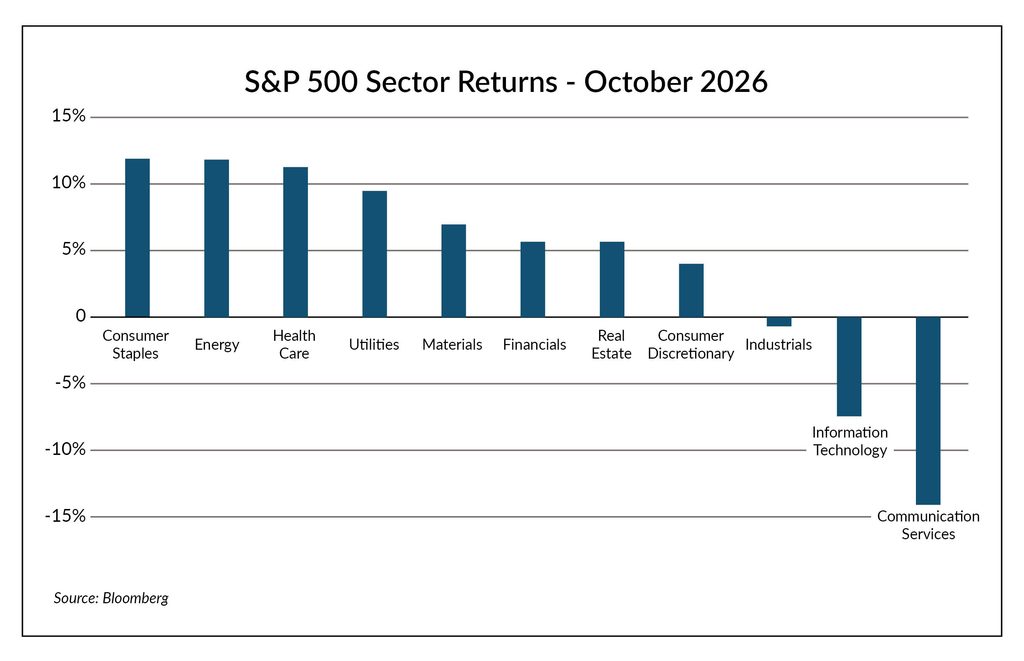
Inflation returned to center stage as hotter-than-expected consumer price data challenged hopes that price pressures would keep moving steadily lower. Treasury yields moved sharply higher following the report before reversing later in the month, while the Federal Reserve left interest rates unchanged but signaled that additional tightening remains possible.
Meanwhile, the economy continued to hold up relatively well. Third-quarter economic growth accelerated to its fastest pace in a year, supported by consumer spending and business investment. While encouraging, that resilience complicates the Federal Reserve’s objectives by supporting demand at a time when inflation remains elevated. Geopolitics added another challenge: the conflict in Iran pushed Brent crude roughly 15% higher and elevated oil prices could add to inflationary pressure.
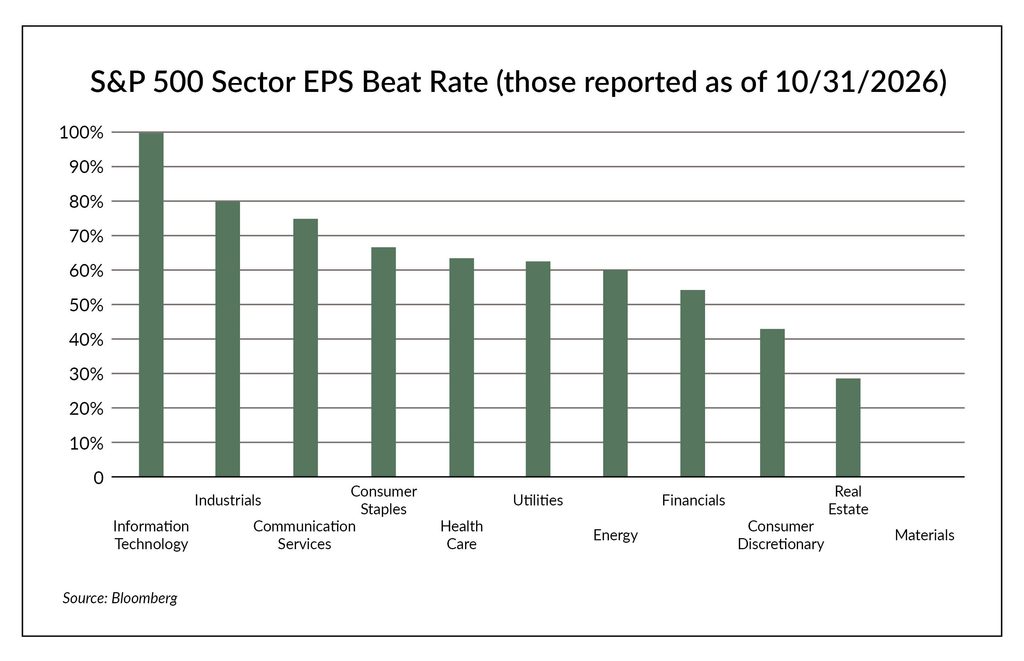
Third-quarter earnings provided perhaps the clearest example of how investor expectations have changed. With roughly 275 of the S&P 500 companies reporting through October 31, approximately 64% exceeded earnings estimates, with earnings surprise rates broadly in line with historical norms. The more consequential story came from the market’s largest technology companies, where investors are increasingly focused on the significant amount of capital being committed to AI and whether that investment is translating quickly enough into profits and cash flow. Results were mixed, not broadly weak, but this earnings season suggested investors are becoming more discerning with AI spending. Markets increasingly want evidence that those investments can generate sustainable revenue, earnings, and free cash flow. October did not necessarily challenge the long-term potential of AI. Rather, investors began asking a different question: which companies will ultimately earn an attractive return on their investment?
After a difficult stretch for fixed income with interest rates spiking, the bond market remained volatile but ultimately rallied in October as yields broadly fell across the yield curve, reflecting the inverse relationship between bond prices and yields. In October, the 10-year Treasury yield fell from 5.24% to 4.93%, while the 2-year yield declined from 4.80% to 4.59%. Although higher yields have created short-term challenges, they may also improve the longer-term return potential of bonds. Credit conditions bear watching as high-yield spreads widened during the month and financing costs increased in some areas associated with the AI infrastructure buildout.
The JNBA Investment Committee remains cautiously positioned toward stocks and constructive on the forward return potential of bonds. This sentiment is driven by current attractive yields. Our investment philosophy is founded on diversification, quality, and flexibility, and we adjust as the balance between risk and opportunity evolves. Heading into November, inflation, monetary policy, and geopolitical tensions remain important factors to watch. Midterm elections will also wrap up, removing another source of uncertainty for investors, a topic we discuss in our latest podcast. For long-term investors, October reinforced an enduring lesson: powerful investment themes matter, but so do price, profitability, and diversification.
As always, please reach out to your JNBA Advisory Team with any questions.
Due to various factors, including changing market conditions and/or applicable laws, the content may no longer be reflective of current opinions or positions. Moreover, you should not assume that any discussion or information contained in this blog serves as the receipt of, or as a substitute for, personalized investment advice from JNBA Financial Advisors, LLC.
Please see important disclosure information at jnba.com/disclosure